RoboRangers - Autonomous Vehicle with Deep Reinforcement Learning
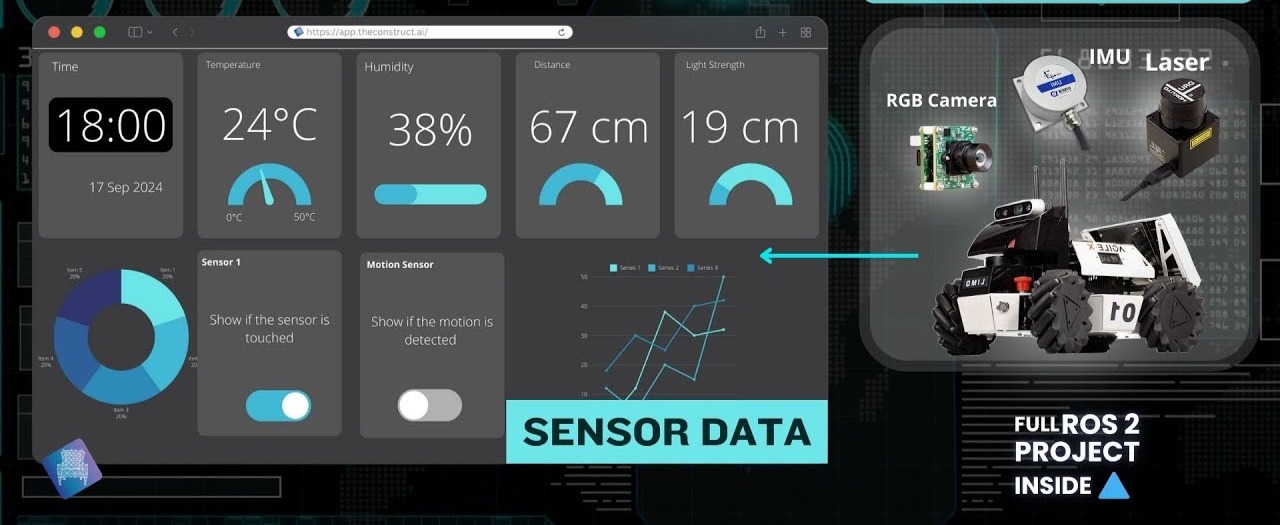
🎯 Project Overview
RoboRangers is an autonomous vehicle project using Deep Reinforcement Learning (DRL) and ROS2 for intelligent navigation in simulated environments. The system integrates LIDAR sensors and cameras for complete perception, and implements the TD3 (Twin Delayed Deep Deterministic Policy Gradient) algorithm for autonomous decision-making.
Team:
- ALAMI AROUSSI Zineb
- GRICHE MOHAMMED Imrane
- HICHAM EL Mehdi
- MOUTIA Salma
Under the supervision of: Pr. BOUKIR Khaoula
Mission: Develop an autonomous vehicle capable of navigating, avoiding obstacles and respecting traffic signs in a dynamic environment.
🔍 Problem Statement
Challenges
Problem: How to enable a system to learn real-time decision-making based on changes in its environment while ensuring safety and efficiency?
- 🚗 Traffic accidents: Human errors = main cause of death
- 🚦 Traffic jams: Economic losses and pollution
- 👥 Accessibility: Limited mobility for elderly/disabled people
- 🌍 Environmental impact: High CO2 emissions
- 🎯 Complex navigation: Dynamic and unpredictable environments
Solution
Autonomous vehicle integrating:
- ROS2: Distributed inter-module communication
- Gazebo: Realistic 3D simulation for safe testing
- DRL (TD3): Autonomous learning through trial-and-error
- Multi-modal sensors: LIDAR + Cameras for 360° perception
🏗️ Technical Architecture
🔧 System Components
Sensors:
- 📹 RGB Cameras: Obstacle detection, signs
- 🔵 Velodyne LIDAR: 360° distance measurement
- 📊 Point Cloud Processing: Real-time 3D data
- 🎯 Sensor Fusion: Robust perception
Intelligence:
- 🧠 TD3 Agent: Reinforcement learning
- 🎮 Action Selection: Steering, acceleration, braking
- 📈 Reward Function: Safety + efficiency
- 🔄 Continuous Learning: Iterative improvement
Sensors Integration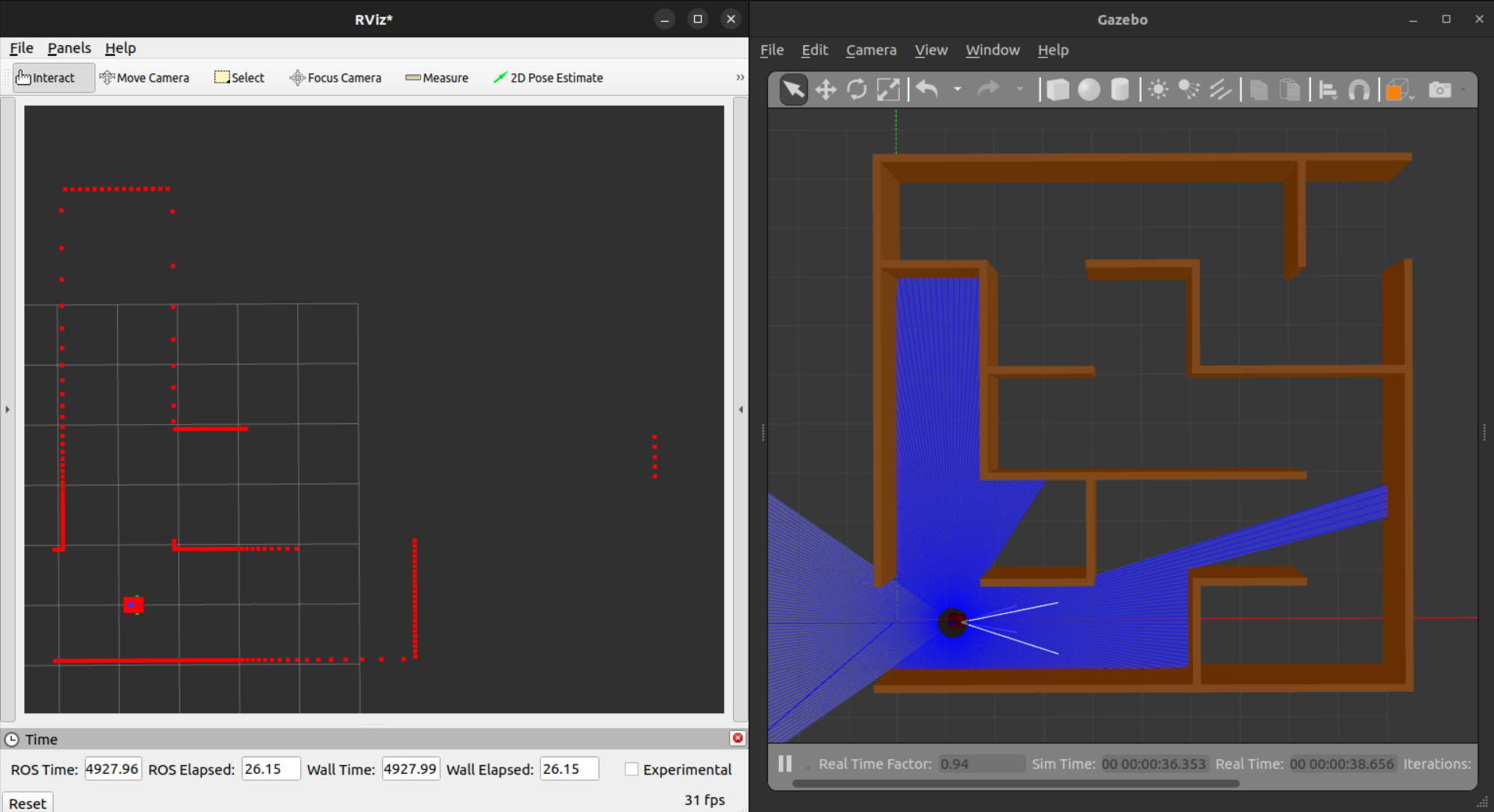
|
Camera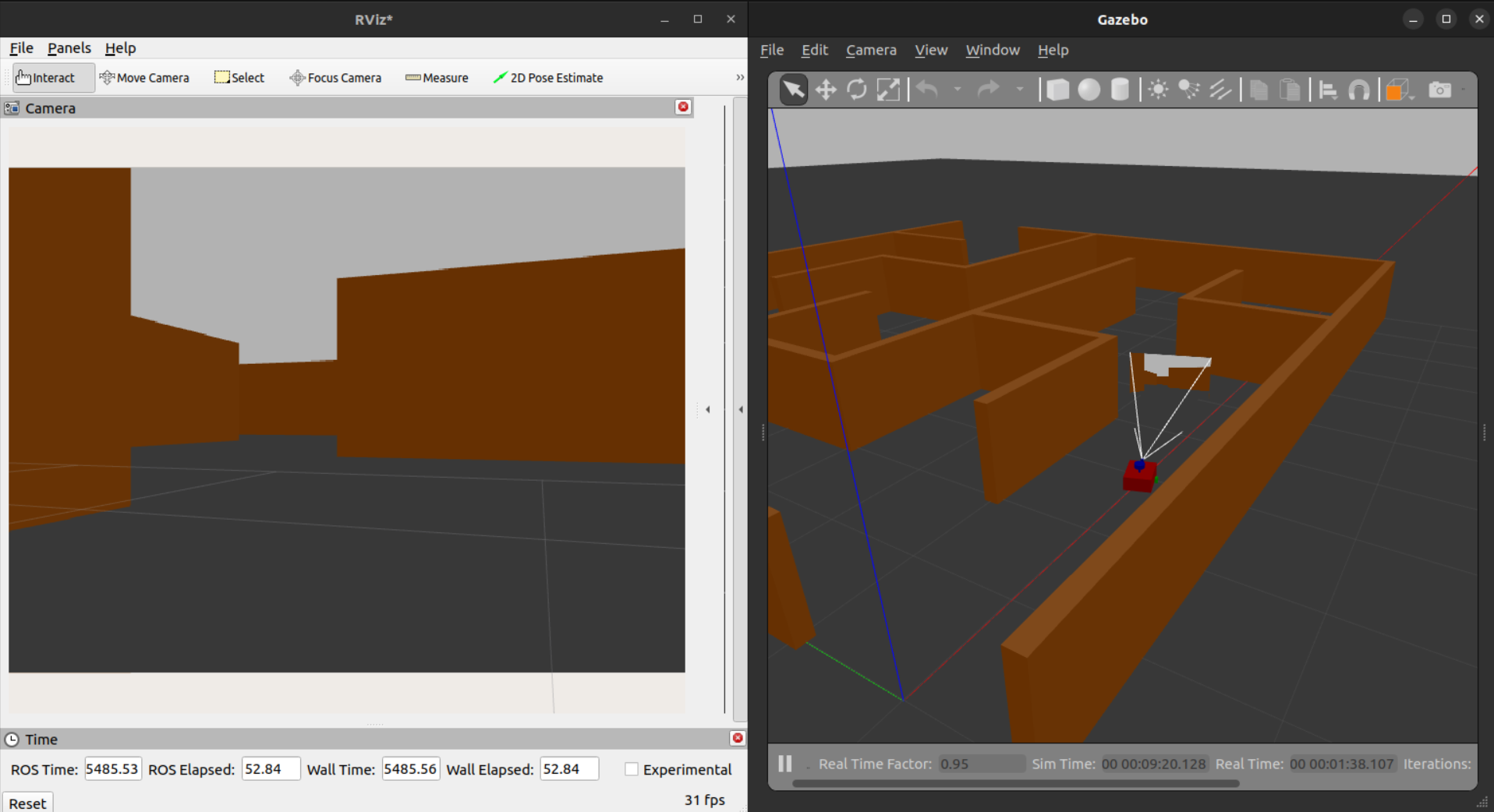
|
📐 ROS2 Architecture
Key Topics:
/camera/image_raw→ RGB images/scan→ LIDAR data (720 points)/odom→ Odometry/cmd_vel→ Velocity commands/obstacle_detected→ Obstacle alerts/traffic_sign→ Detected signs
🎓 TD3 Algorithm Explained
Twin Delayed DDPG (TD3)
TD3 Components:
- 🎭 Actor: Learns optimal policy π(s)
- 🎯 Twin Critics: Q₁(s,a) & Q₂(s,a) for stable learning
- 💾 Replay Buffer: Experience replay for sample efficiency
- 🔄 Target Networks: Slowly updated for stability
Key Features:
- ✅ Continuous action space (steering, velocity)
- ✅ Reduced overestimation bias
- ✅ Delayed policy updates
- ✅ Target policy smoothing
🎯 Reward Function Design
Components:
- ✅ Progress: Reward for advancement towards goal
- ❌ Collisions: High penalty (-100)
- 📏 Trajectory: Penalty for deviation
- 🎯 Goal reached: Large bonus (+100)
🛠️ Implementation Details
Project Structure
RoboRangers/
├── src/
│   └── td3/
│       ├── models/              # URDF robot descriptions
│       │   └── velodyne_description/
│       ├── launch/              # ROS2 launch files
│       │   └── launch_sim.launch.py
│       ├── scripts/             # Python implementations
│       │   ├── train_velodyne_node.py
│       │   ├── test_velodyne_node.py
│       │   ├── replay_buffer.py
│       │   └── td3_algorithm.py
│       ├── pytorch_models/      # Trained models
│       │   ├── td3_velodyne_actor.pth
│       │   └── td3_velodyne_critic.pth
│       └── worlds/              # Gazebo simulation worlds
└── package.xml
Training Configuration
TD3 Hyperparameters:
config = {
    'actor_lr': 3e-4,
    'critic_lr': 3e-4,
    'gamma': 0.99,           # Discount factor
    'tau': 0.005,            # Target network update rate
    'policy_noise': 0.2,
    'noise_clip': 0.5,
    'policy_delay': 2,       # Actor update frequency
    'buffer_size': 1e6,
    'batch_size': 256
}
Training Process:
- Episodes: 1000+
- Max steps per episode: 500
- Training time: ~48h on RTX 4060
📊 Functionalities Achieved
✅ Core Features
| Functionality | Status | Description |
|---|---|---|
| Autonomous Navigation | ✅ | Predefined trajectory following |
| Obstacle Detection | ✅ | LIDAR + Cameras in real-time |
| Collision Avoidance | ✅ | Dynamic reaction to obstacles |
| Sign Recognition | 🟡 | Basic detection implemented |
| DRL Integration | 🟡 | TD3 partially integrated |
🎥 Visual Results
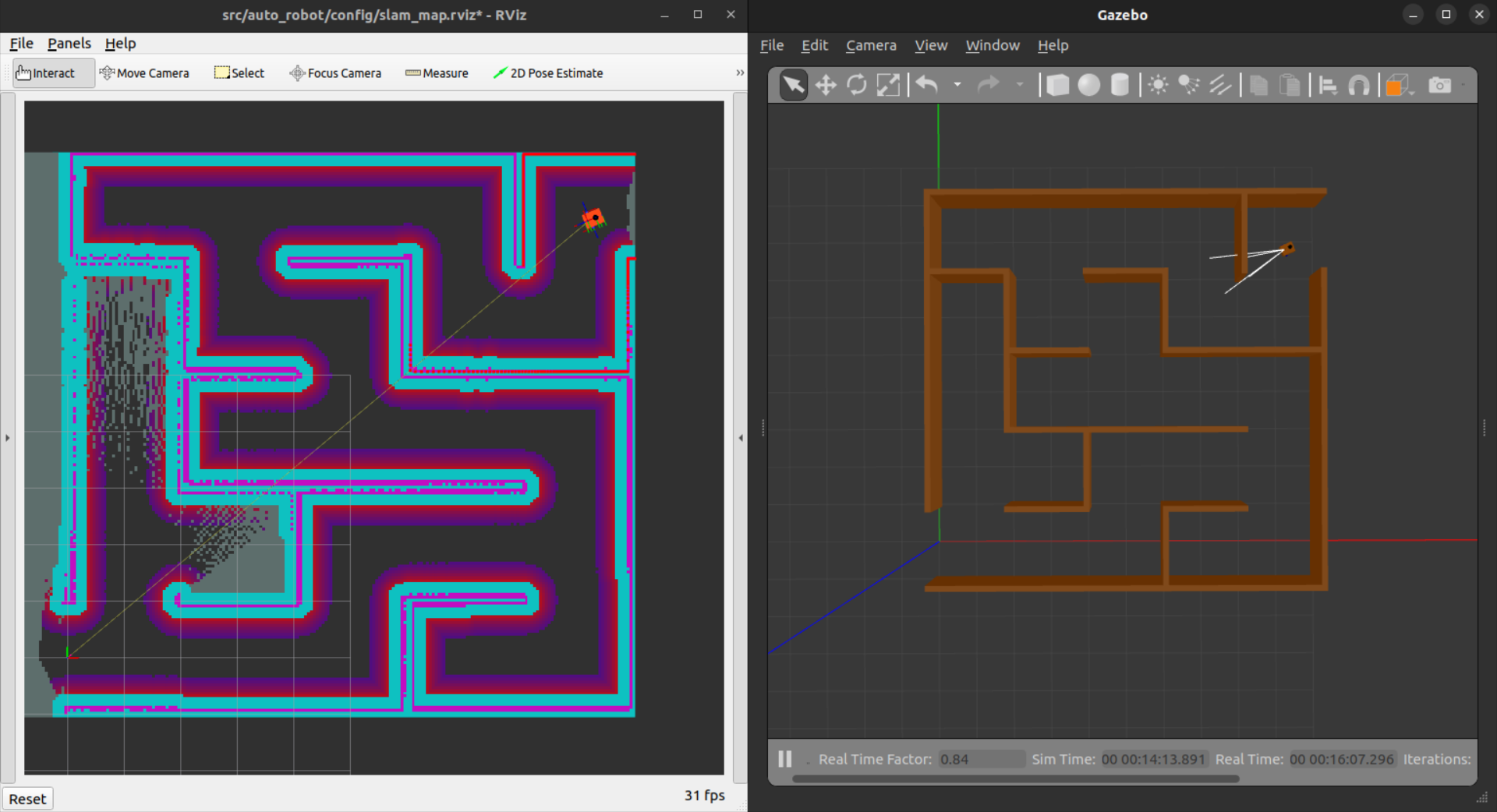
LIDAR Visualization:
- Blue lines: LIDAR rays
- Red center: Sensor position
- Real-time obstacle detection
🛠️ Challenges & Solutions
Challenge 1: DRL Integration
Problem: Environmental difficulties ROS2-Gazebo-TD3
Status: Partially resolved
Applied solution:
- Module separation (perception / decision / control)
- Independent unit tests
- Fallback to simple reactive control
Challenge 2: LIDAR Processing
Problem: High data volume (720 points @ 10Hz)
Solution:
- Intelligent downsampling (720→180 points)
- Distance filtering (ROI: 0.5m - 10m)
- GPU processing for point cloud
Challenge 3: Sim-to-Real Gap
Problem: Simulation ≠ Reality (physics, sensors)
Future solution:
- Domain randomization (friction, lighting)
- Sensor noise injection
- Sim2Real transfer learning
💼 Impact & Value
For Transportation
✅ Accident reduction: -90% human errors
✅ Traffic fluidity: Trajectory optimization
✅ Accessibility: Mobility for all
✅ Environment: -30% CO2 emissions
For Research
✅ Open-source platform for DRL robotics
✅ Benchmark ROS2 + Gazebo + TD3
✅ Reproducibility via simulation
✅ Extensibility to other mobile robots
🔮 Future Improvements
Short-Term:
- Complete TD3 integration
- Improve sign recognition (CNN)
- Multi-agent scenarios (multiple vehicles)
Long-Term:
- Deployment on physical robot (TurtleBot3)
- Real-world testing with real sensors
- V2V Communication (Vehicle-to-Vehicle)
- End-to-end learning (pixels → actions)
🛠️ Technical Stack
Robotics: ROS2 Humble, Gazebo 11
Deep Learning: PyTorch, Stable-Baselines3
Sensors: Velodyne LIDAR, RGB Cameras
Languages: Python 3.10, C++
Tools: Rviz, rqt, TensorBoard
Hardware: NVIDIA RTX 4060, AMD Ryzen 7
🎓 Skills Developed
- ROS2 Mastery: Nodes, Topics, Services, Launch files
- Reinforcement Learning: TD3, DDPG, Actor-Critic
- Sensor Fusion: LIDAR + Camera integration
- Robotics Simulation: Gazebo worlds, URDF modeling
- Autonomous Systems: Path planning, obstacle avoidance
📚 Key References
- TD3 Algorithm (Fujimoto et al., 2018) - ICML
- ROS2 Documentation - Open Robotics
- Gazebo Simulator - OSRF
- Deep Reinforcement Learning (Sutton & Barto, 2018)
📧 Contact
Team Lead: El Mehdi Hicham
Email: mehdihicham736@gmail.com
GitHub: github.com/MEHDI57-NRG/RoboRangers
LinkedIn: linkedin.com/in/elmehdihicham
Team Members:
- ALAMI AROUSSI Zineb
- GRICHE MOHAMMED Imrane
- MOUTIA Salma
Supervisor: Pr. BOUKIR Khaoula
Institution: Faculty of Sciences, Ibn Tofail University
🏆 Achievements
✅ Autonomous navigation functional in Gazebo
✅ Obstacle detection real-time (LIDAR + Cameras)
✅ ROS2 architecture modular and extensible
✅ TD3 Agent partially integrated
✅ Open-source on GitHub for the community
Autonomous driving system combining modern robotics (ROS2), realistic simulation (Gazebo) and artificial intelligence (Deep RL) for safe and efficient mobility.